


Philippines police unlawfully targeted protesters with unnecessary and excessive force during anti-corruption marches in September, according to harrowing new testimony gathered by Amnesty International ahead of fresh protests planned across the country this weekend.
Ten people interviewed by Amnesty International detailed physical abuse – including violations that may amount to torture and other ill-treatment – by state forces following demonstrations in the capital Manila on 21 September 2025. The research comes as thousands prepare to return to the streets on 30 November in renewed protests against government corruption.
“The disturbing evidence we have gathered of unlawful force unleashed by the police against protesters and others on 21 September makes a mockery of the Philippine government’s repeated claim that it exercises ‘maximum tolerance’ during protests,” said Jerrie Abella, Amnesty International Regional Campaigner.
“Victims have described how police punched, kicked and hit people – including children – with batons as they were arrested, with appalling ill-treatment continuing in detention. The police must change course and respect people’s right to protest on 30 November and beyond.”
Police only stopped beatings ‘when they saw the media coming’
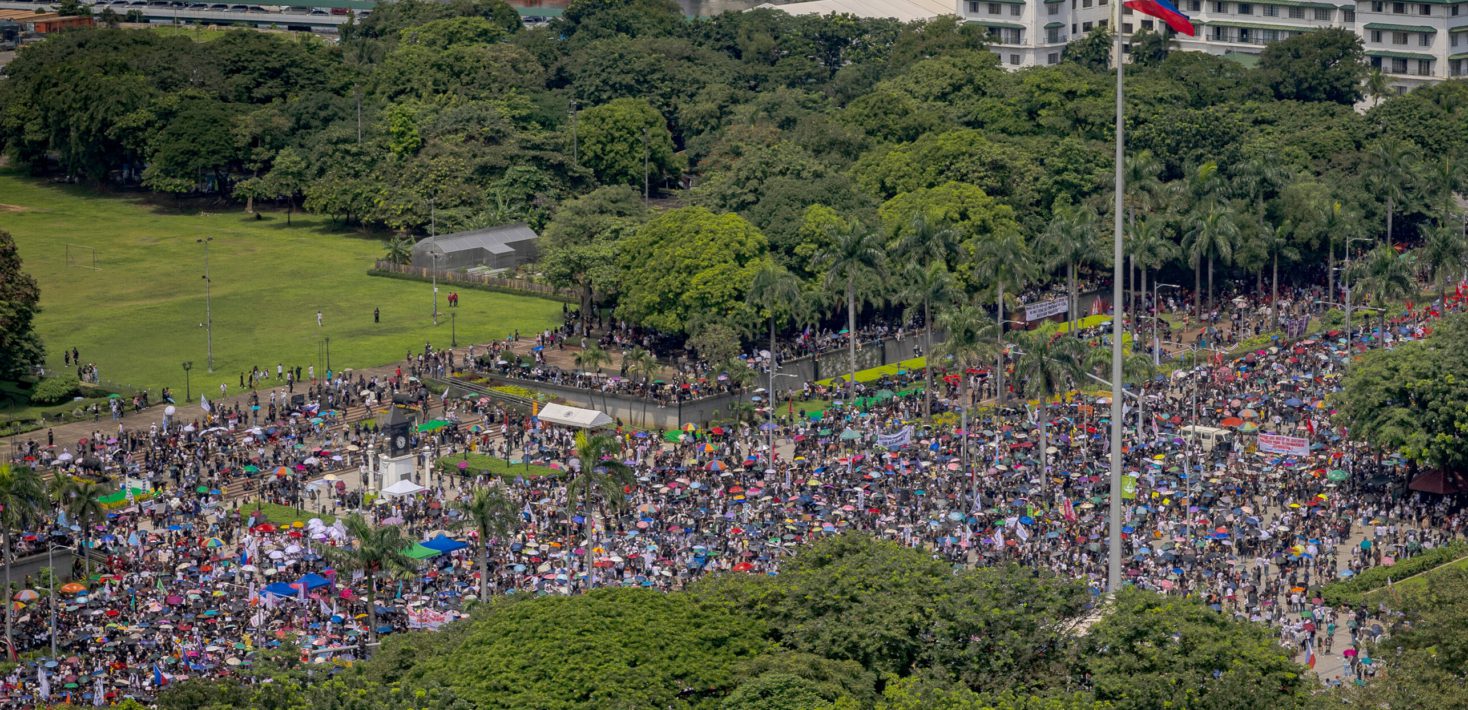
The Philippines’ biggest demonstrations in years took place on 21 September, as tens of thousands in Manila and elsewhere protested against corruption by government officials, high-level politicians and contractors in flood-control and infrastructure projects.
Isolated incidents of violence from some protesters, including setting vehicles on fire and throwing stones at the police, were reported in Manila. Manila police said they arrested and detained 216 people who were allegedly involved in the violence, including 91 children. Many are facing criminal charges.
However, Amnesty’s research indicates that peaceful protesters and bystanders were also violently targeted by the police.
Rey*, 20, recounted how three men in plain clothes – who he believes were police as they later handed him to uniformed officers – grabbed and punched him in the face as he tried to run away while holding a sign calling on people to take to the streets. The assault on Rey was captured in a video, by an unknown individual, which he found online and showed to Amnesty International.
“Police in uniform joined in to punch, kick and hit me with their batons. I briefly lost consciousness but woke up to pain as they dragged me by my hair,” Rey told Amnesty International.
I told myself, I was done for. I’d never make it out of this tent alive.
He said police accused him of taking part in violence that killed two officers, despite the fact that no police were killed in the protests. Rey said the beating only stopped when one officer warned the others that members of the media were approaching. He also described how he and his friend were taken by uniformed police into an ambulance, where they were beaten further.
Omar*, 25, said he was watching the protests with relatives in Mendiola Street, Manila when he was arrested. Police accused him of being among those who caused violence, including attacking the police. While walking with the police who arrested him, Omar said they passed other officers who punched and hit him with batons. He said he was then held in a tent with around 14 other people, one of whom “had blood dripping from a head wound” which he said was from being hit with a gun by a police officer.
Ahmed*, 17, was arrested alongside his relatives Yusuf*, 18, and Ali*, 19, who all live and do construction work near the protest site. They said they went out to buy rice and were waiting for police to allow them to pass through a protest area on their way back to the construction site when they were arrested.
“The police took us to a tent where they hit us with their batons. They punched us in the face and kicked our torsos,” Ali told Amnesty International. He said they were accused of attacking the police and subsequently detained.
‘I saw people coming out of the tent bloodied and bruised’
Greg*, 18, and Ryan*, 22, were arrested in separate incidents in Mendiola and Ayala Bridge in Manila for their alleged involvement in attacks against the police. Like all those interviewed, they were brought by the police to a blue tent in Mendiola, where police beat them further.
Lawyer Maria Sol Taule, from a legal aid group representing those interviewed, said the “notorious blue tent” served as a temporary holding area for those arrested. While it showed no outward sign of police affiliation, it appeared to be supervised by the police, according to the group’s investigation.
“I was so scared. I saw people coming out of the tent bloodied and bruised. Inside, they made me spread my hands and repeatedly hit both sides with their batons,” said Greg, who showed Amnesty International welts on his back where he said he was struck.
Ryan said police hit him on his head and neck. “They saw me lift my head up and accused me of ‘verifying’ or looking at the faces of police to identify them,” he said. Others interviewed reported being similarly hit following the same accusation by police.
“I told myself, I was done for. I’d never make it out of this tent alive,” said Michael*, 23, who described being punched, kicked and hit with batons by police. He was arrested with his girlfriend Sam*, 21, and their friend Lena*, 22, before all three were detained at a police station. They said they went to the protest just to watch and take videos but were arrested for allegedly committing violence.
Sam and Lena were not hurt but could hear people being beaten nearby. “Even now, I can still hear the cries coming from the tent. I have problems sleeping, imagining how they beat up Michael,” Sam said.
The beatings were so severe that some victims needed medical treatment, according to Taule. She said one individual sustained injuries including a dislocated jaw when he was hit by the police with a baton in the face. Others – including Michael, Sam and Lena – lost their jobs after failing to report to work as they were detained.
All those interviewed maintained they were not involved in the violence of which they were accused by the police.
Manila police have denied allegations of torture and other ill-treatment, maintaining they continued to observe “maximum tolerance” even while some protesters committed violence.
International standards require police to always apply non-violent means first before resorting to force, and as a rule force must not be used against peaceful protesters. Even where some protesters engage in acts of violence, and the use of force becomes unavoidable, law enforcement must use only the minimum necessary force to achieve a legitimate objective. The use of force for the purpose of punishment is prohibited at all times.
“These testimonies indicate that police brazenly flouted these standards, using isolated incidents of violence as an excuse to brutally crack down on peaceful protesters and bystanders, and using force to punish them,” Jerrie Abella said.
“It is crucial that these violations by the Manila police are promptly, impartially and effectively investigated and that the officers responsible are held accountable.”
Detention beyond maximum period allowed by law
Many of those arrested were detained for at least 10 days after their arrest and only released after posting bail of PhP 18,000 (USD 304) each.
On 25 September, lawyers’ groups filed a court motion seeking the release of over 100 people still detained without charge, or beyond the maximum 36 hours of detention allowed for warrantless arrests under Philippine law.
Only those who had undergone inquest proceedings were subsequently released that day.
On 4 November, police said 97 individuals had been charged with conspiracy, sedition and other crimes over the protests.
Police said they released all children three days after their arrest. However, a children’s rights advocate supporting some children, who requested anonymity for their safety, told Amnesty the last detained child was released on 29 September, more than a week after being arrested.
According to the advocate, the children were arrested and beaten by the police during arrest and inside the tent, detained, and forced to do hours of community service upon release as “punishment”. The children were either bystanders who did not participate in the protests or protesters who maintained they were not involved in violent acts, the advocate said.
Investigation needed into allegations of torture and other ill-treatment and unlawful use of force
Amnesty International calls on the Philippine government to promptly, impartially and effectively investigate the unlawful use of force by the Manila police and all allegations of torture and other ill-treatment and to guarantee effective remedies and reparations for all victims.
Particular measures must be taken to facilitate children to exercise their right to freedom of peaceful assembly and protect them from unlawful use of force, noting that they are particularly vulnerable to its harmful impact.
Philippine authorities policing protests should also ensure full adherence to international standards, including the UN Basic Principles on the Use of Force and Firearms by Law Enforcement Officials.
“Philippine authorities have an obligation to maintain law and order but also to respect and protect the rights to freedom of expression and peaceful assembly. Charges against people arrested solely for exercising these rights must be dropped,” Jerrie Abella said.
“Filipinos peacefully taking to the streets this weekend have a right to protest against corruption without fear. The police must ensure their safety, not target them with violence.”
*Names were changed upon request for safety reasons.